
Interviews · 23 min read · Updated November 2026
What I Learned From 13 Private Equity Interview Tests
The clocks, starting files, deliverables and lessons behind the practice cases I recreated from my own interviews.
One firm gave me an Excel template. Another started me with a blank workbook. Both gave me an hour. For a take-home, I built a model to decide what I’d pay, but the only thing I had to send back was the memo.
When I was recruiting, I spent hours looking for realistic middle-market and lower-middle-market practice cases. I often fell back on a public-company LBO template. What I wanted was to open the files I might actually get, start the clock and see if I could make a recommendation before time ran out.
I kept the files I turned in. When I rebuilt one model, I found I’d overstated the return by more than seven percentage points. In another case, the price I recommended missed my own return target. Several of these tests still got me to the next round, mistakes and all.
Before you practice, find out how much time you have, what you’ll start with and what you have to hand in. If you have three hours to finish an investment committee deck, you need to practice choosing what goes on the slides while there’s still time to finish them.
The assignments at a glance
I took 13 assignments across several hiring processes. I describe 11 formats here: eight timed tests, two take-homes and one investment discussion. I keep the details of two assignments private.
How to read the comparison. The formats come from my interviews. The company names and model figures come from the practice editions I recreated. A take-home window tells you when the work is due. The timed assignments tell you how long you have to do it.
Choose a time to compare its assignments. Select a case name to jump to its write-up.
- About an hour
- Port AlderModel and short answersJuniper TraceBase and downside models
- Several hours
- BramblewickFull LBO workbookForgeModel and brief memoLarchInvestment committee slidesRedwickModel and presentationMeadowlarkCommercial analysisKestrelValuation and write-up
- Take-home
- PenwickUnderwriting and memoThreadwellInvestment memo
- Discussion
- Lantern CourtOral discussion
Two additional assignments are included in the full table without a published time or hand-in.
Open full-size figure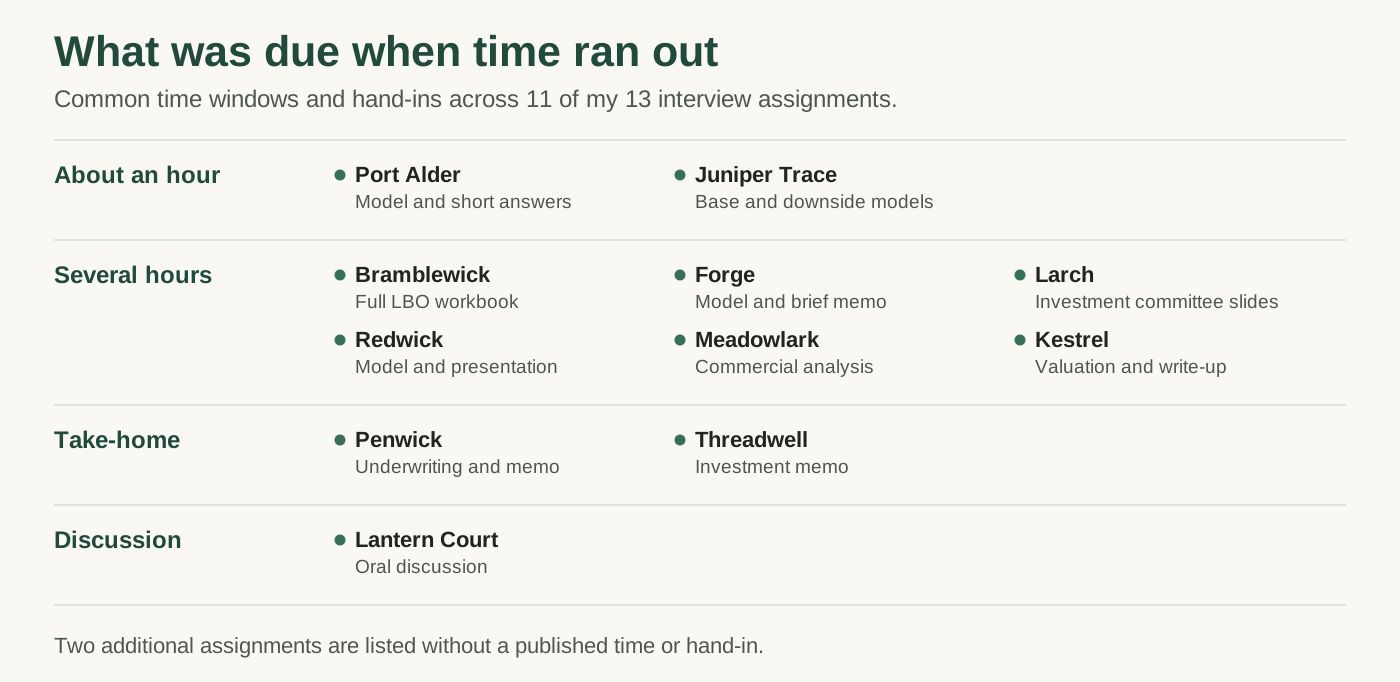
All 13 assignments
| Format and practice case | Time available | Starting materials | Required output | Decision left to the candidate |
|---|---|---|---|---|
| Template LBO. Port Alder1 | About an hour | Model template | Completed model and short answers | Which assumption matters most to the return? |
| Downside modeling. Juniper Trace2 | About an hour | Written instructions | Base and downside cases | How much downside can the investment absorb? |
| Full model build. Bramblewick3 | Several hours | Company materials and financials | Completed LBO workbook | Which financing and purchase price can the business support? |
| Model and memo. Forge4 | Several hours | Company materials and financials | Basic model and brief recommendation | Would you invest at the price you modeled? |
| Investment presentation. Larch5 | Several hours | Company materials and financials | Investment committee slides | Which facts support or weaken the recommendation? |
| Additional modeling exercise | ||||
| Model and presentation. Redwick7 | Several hours | Company materials and financials | LBO model and presentation | How sensitive are returns to the operating case? |
| Commercial analysis. Meadowlark8 | Several hours | Operating data | Analysis and brief presentation | What does the commercial evidence tell you? |
| Valuation and write-up. Kestrel9 | Several hours | Company materials | Model and written recommendation | What is the highest price you would support? |
| Take-home underwriting. Penwick10 | Take-home | Company materials and financials | Underwriting and investment memo | What should the team verify before bidding? |
| Take-home memo. Threadwell11 | Take-home | Company materials | Investment memo | Which risk most affects the investment thesis? |
| Private assignment | ||||
| Investment discussion. Lantern Court13 | Discussion | Company background | Oral discussion | How would you defend your recommendation? |
If you want to see a complete example before choosing what to practice, the Port Alder test is free. It includes the template, the submitted model, the corrected answer and the debrief. No signup is required.
60-minute LBO tests: template or blank workbook
A template lets you start with the formulas. With a blank workbook, even deciding where the assumptions go comes out of your hour. Port Alder and Juniper Trace both allowed 60 minutes, but I had different jobs to finish.
Port Alder: finish the model and answer the questions
The test behind Port Alder was live on Zoom with my screen shared. The firm supplied a template and asked me to return it after an hour, even if it was incomplete. I had to build cash flow, repay senior debt before subordinated debt, calculate returns and answer three written questions.
I finished the model, but three formulas were wrong. My tax line multiplied pre-tax income by one minus the tax rate. That gave me after-tax income where the model needed the tax bill. In the recreated case, fixing that formula alone takes the IRR from 17.0% to 22.6%. Inventory growth had the wrong cash-flow sign, and a subordinated-interest reference shifted when I copied it across. Fix those two and the final IRR is 21.4%.
I got the chance to correct the model after the timed round. The cash-tax fix raised the return, while the inventory and interest fixes brought it back down.
I’d leave a few minutes for the written questions and three checks. Trace cash taxes, look at what happens to cash when inventory grows, and inspect the last year of the debt schedule after copying the formulas across.
Juniper Trace: build the structure and define a recession
Juniper Trace gave me a one-page prompt and an hour to build from my own blank workbook. I had to link the financial statements, model a recession in year two alongside a base case, and set the workbook up to print.
The recession assumptions were mine to choose. That meant deciding what happened to sales, margins, working capital and capex, then explaining the consequences.
My returns worked, but I’d left out goodwill and a balance check. Opening PP&E started at zero, and the year columns split across pages when printed. Next time I’d add a balance check as soon as I lay out the statements, so I can catch a missing line while I’m building.
Practice building from an empty workbook and put both cases on one output page. Look at what happens to debt in the recession year. Falling sales can release working capital, and lower capex can leave more cash to repay debt even as earnings fall.
3-hour PE case studies: model, memo or IC deck
Bramblewick gave me the full three hours for Excel. At Forge I needed time to write. At Larch the investment committee (IC) deck was the only thing I had to hand in.
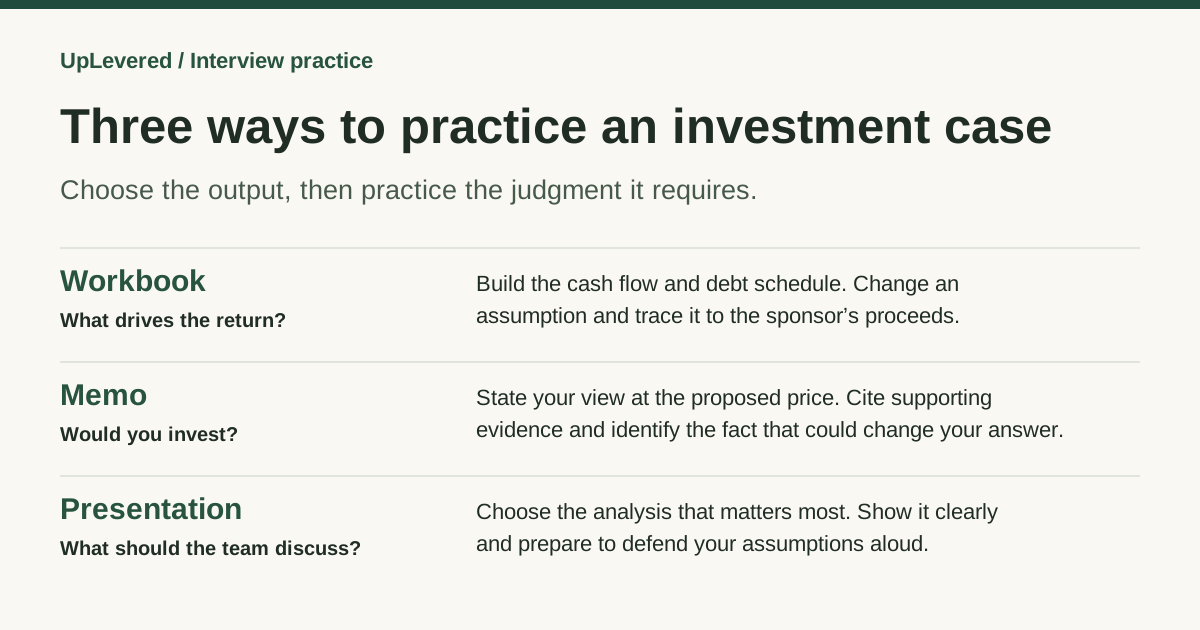
- Workbook
- What drives the return?
Build the cash flow and debt schedule. Change an assumption and trace it to the sponsor’s proceeds.
- Memo
- Would you invest?
State your view at the proposed price. Cite supporting evidence and identify the fact that could change your answer.
- Presentation
- What should the team discuss?
Choose the analysis that matters most. Show it clearly and prepare to defend your assumptions aloud.
Bramblewick: the financing instructions were part of the model
Bramblewick required a full LBO from scratch. I had to build the purchase price allocation, opening balance sheet, linked statements, debt schedules, revolver, exit waterfall and return sensitivities. The model was the whole submission.
Buried in the financial workbook was an instruction to fund growth capex with a separate term loan. I missed it. My model drew on the revolver to cover the spending.
I also gave the seller 10% of the new equity because the seller rolled 10% of the sale proceeds. Those percentages have different denominators. If the seller rolls $10 million of a $100 million sale and the sponsor contributes $40 million, the seller owns $10 million of $50 million, or 20%, assuming both buy the same class at the same price.
I’d turn the financing instructions into a checklist before opening Excel. Build the term loan into the debt schedule, then test the revolver by making the business run short of cash. A base case that never draws on it won’t tell you if it works.
Forge: the memo needs its own time
Forge paired a high-level LBO with a one-page memo. The files supplied no purchase price, debt terms or return hurdle. I had to choose the assumptions and use the page to explain the investment highlights, risks and recommendation.
I left the memo until late and barely finished. The other problem was units. The presentation used millions, and the workbook switched between dollars and thousands.
When I reviewed my model, I found I’d calculated forecast EBITDA as net income plus D&A. That left out interest and tax, so entry and exit used different earnings definitions. I’d also typed 300 where I meant 300,000 of minimum cash.
I’d set up the memo headings before going deep into Excel. As you read, jot down the facts that support your price and the risks that could change it. Before exporting, check the units, the EBITDA definition and the ownership period against the model.
Larch: a six-slide limit forces selection
Larch required a PowerPoint investment committee memo of no more than six slides. I had more supporting data than I could use, including customer sales and EBITDA adjustments. A valuation and sources and uses were required even if I recommended not bidding.
I sent a cover plus six slides. I still had unfinished slides. Worse, the source-file subtotal skipped some of the largest customers. I carried that incorrect total into the deck.
I’d practice finishing the deck within the six-slide limit. Start with the recommendation, give each slide a job, and check the most important source subtotal yourself. Adding up the customer rows would have caught mine.
Four to six hours adds more underwriting
The longer timed cases gave me more information to interpret and more assumptions to own. They also made it easier to spend too long on a supporting analysis and leave the investment answer unfinished.
Redwick: acquired EBITDA needs a purchase price
Redwick asked for a model in Excel and PDF, plus two or three slides. The original instructions repeatedly made the financial analysis the priority. The business grew through acquisitions, so the forecast needed a view on both operating performance and future deals.
My model added acquisition EBITDA without paying for the acquisitions. That made the growth appear much more attractive than it was. In the recreated three-year case, paying for acquisitions and applying the other corrections cuts the modeled return by more than seven percentage points.
Even at 23.1%, I’m assuming the lender funds the additional draws. And when I looked back at my slides, some tables still showed the numbers from an earlier model.
For a buy-and-build case, pick one acquisition and follow it through the model. Where’s the purchase payment? Who funds it? What does that do to interest, sponsor ownership and exit proceeds? Then update the slide tables from the final workbook.
Meadowlark: the data analysis had to explain change
Meadowlark was a four-hour commercial analysis exercise. The current recreation contains more than 200,000 sales rows. The assignment asked for Excel analysis and a brief presentation answering customer and product questions, including whether the firm should spend more time on the deal. It did not ask for an LBO.
The written feedback asked for year-by-year customer and product trends. I’d given the team one consolidated five-year view. They also called out hardcoded Excel outputs that were hard to audit.
When I went back through the workbook, I found I’d ranked an intercompany account as a customer, compared a partial year with full years and treated missing cost data as a margin improvement. Two slides were unfinished. I’d left the team’s last question unanswered. Was the deal worth more of their time?
First, check which rows are outside customers, which periods are comparable and whether the cost data is complete. Then explain what drove the changes in sales. Which customers did the company win or lose? How much came from price versus volume? Save a slide to say whether you’d keep working on the deal.
Kestrel: the price had to follow my own assumptions
Kestrel asked me to model a carve-out and defend my price. That meant deciding which costs the business would have to cover once it was operating on its own.
I wrote that my growth assumptions were conservative. Most of the revenue forecast was still hardcoded to management’s numbers. In the teaching model, linking the assumptions and finishing the other corrections took the five-year IRR below my 25% hurdle. At a flat entry and exit multiple, I would have needed to bid about 6.0x EBITDA to clear it.
Change a growth input and follow it through revenue, cash flow, debt and returns. If the IRR barely moves, find out why before quoting it. The separate example below isolates the last step. At the same sale price, how much does the sponsor keep when more debt is still outstanding?
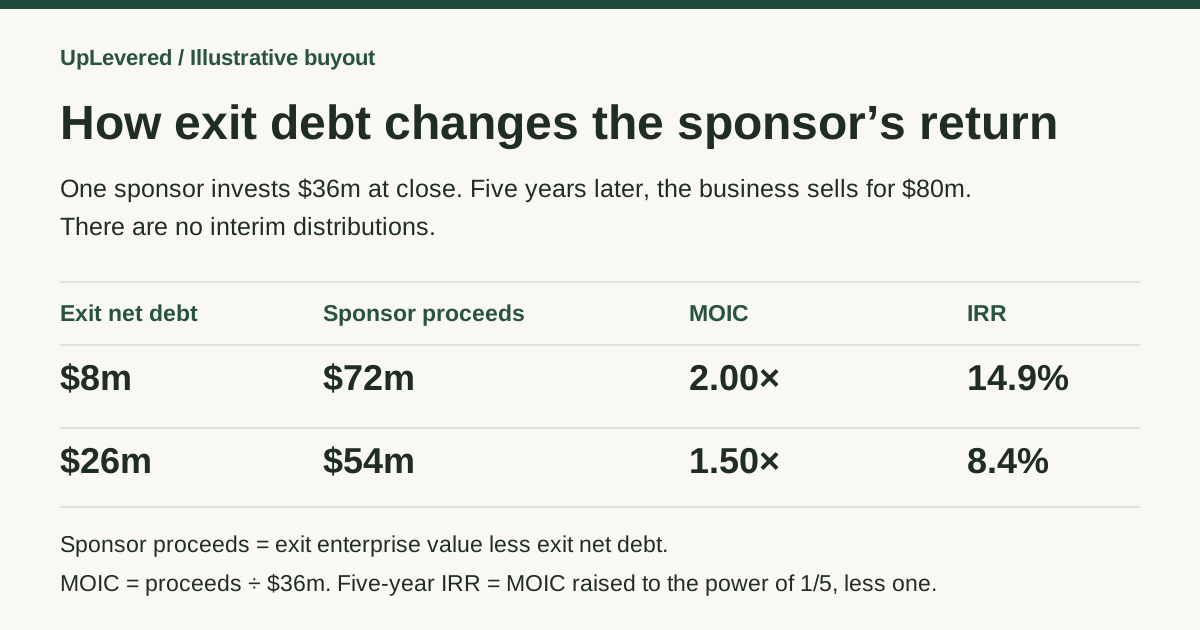
Illustrative five-year buyout. The sole sponsor invests $36m at close and receives no interim distributions. The business sells for $80m in both scenarios.
| Exit net debt | Sponsor proceeds | MOIC | IRR |
|---|---|---|---|
| $8m | $72m | 2.00× | 14.9% |
| $26m | $54m | 1.50× | 8.4% |
Subtract exit net debt from enterprise value, then divide proceeds by the initial equity check. With just the entry and exit cash flows, annual IRR equals MOIC raised to the power of 1/5, less one.
Take-home PE case studies
A longer submission window gives you time to investigate and write, but the model, recommendation and assumptions still have to agree. The two examples here asked for different combinations of those outputs.
Penwick: identify the question that changes the price
Penwick asked me to recommend a valuation range and identify the information I still needed. One expense line mattered enough to change my bid.
I’d subtracted costs that were already excluded from the expense line. Once I corrected the historical figures, a pattern stood out. The expense stayed roughly flat while sales grew.
In the recreated workbook, using the average historical share of sales gives an 11.1% five-year IRR. Using the latest year’s share gives 19.8%. The version with the misstated history also rounded to 19.8%, so the matching return hid the error. Both forecasts assume the expense moves with sales. In the separate example below, try holding it fixed in dollars and see what share of next year’s sales it takes.
My first diligence request would be a breakdown of that expense. Which costs stay fixed, and which rise with sales?
Threadwell: a buy recommendation needed a price
Threadwell supplied a presentation and asked for a maximum two-page memo. The required sections included the investment thesis, post-close actions, ranked highlights, ranked risks and mitigants, and a recommendation. If I recommended buying, I had to name my price. No model submission was required.
I built a working model anyway. It helped me choose the price, but it omitted taxes, charged different interest rates from the memo and used a different holding period. In the recreated case, using the memo’s terms brings the base-case IRR down to 16.9%. The workbook had made the bid look more attractive than the memo justified.
For a memo-only case, build enough analysis to support the decision. Before you send it, read every number in the memo against the workbook. In my case, checking the interest rate and the exit year alone would’ve caught two inconsistencies.
The discussion case required no submission
For Lantern Court, I had to defend an investment view aloud. I had time to read the memorandum before the call. The deliverable was the conversation itself.
The questions covered investment merits and risks, diligence, the industry, competitive position and how the view might change ten years later. They wanted to know what I’d investigate first, what analysis I’d run and which data I’d ask for.
I prepared notes and built two quick LBOs for my own use. The conversation itself focused on whether the industry was attractive, how long the company could keep its competitive advantage and where growth would come from.
Practice explaining the investment in two minutes, then have someone interrupt. Be ready to name the biggest threat to your thesis and the first diligence question you’d ask to find out whether you’re wrong.
Two other assignments
An additional modeling exercise
One habit I’d carry into another modeling test is to save an early version with a working return calculation. Then change one input you can defend and see if it moves the recommendation. It’s easier to spot a broken link before the final minutes.
Private assignment
I’ve included this one in my count and kept its instructions and results private.
How I’d prepare for my next test
1. Confirm the assignment before the clock starts
Ask what files you’ll receive, what you’re allowed to use, what you have to return and whether there’s a page or slide limit. If you’ll discuss the work afterward, find out when. For a take-home, confirm the due date, time and time zone.
2. Practice the full output
If the test needs a memo, write the memo during practice. If the limit is six slides, finish the deck within that limit. If the model will be printed, check the printout. If it is a discussion, say the recommendation aloud and take questions.
Save the version you have when the timer goes off. Make corrections in a copy. When you compare the two, you’ll see what you can actually finish under pressure.
3. Check the connections that drive the recommendation
| Check | What to inspect |
|---|---|
| Source data | Units, dates, customer population, comparable periods and important subtotals |
| Transaction | Sources equal uses after accounting for acquired cash, debt repayment and fees |
| Ownership | Rollover proceeds and management participation produce the correct sponsor share |
| Forecast | Changing an assumption changes the intended revenue, cost or cash-flow line |
| Cash flow | Tax and working-capital signs, plus the funding for capex and acquisitions |
| Debt | Borrowing, repayment and interest match the stated terms, rates and balances |
| Returns | Entry and exit use consistent EBITDA definitions, and the hold starts at ownership |
| Written answer | Price, financing, cases, returns and downside claims match the final workbook |
For more examples, the LBO modeling traps guide walks through the formulas behind checks like these.
4. Finish with a decision and a question
End with two answers. What would you do at this price? What would you need to learn before you committed money?
If you’d pursue the deal, give the price range and the margin or customer question that could change it. If you’d pass at the seller’s price, say so and show the assumption that drove your decision.
Questions candidates ask
How long does a private equity modeling test take?
Of the 11 formats described here, eight were timed tests lasting 60 minutes to six hours. Two were take-homes and one ended with a discussion.
Does every PE case study require a three-statement LBO?
No. I had to build linked financial statements for Juniper Trace. Meadowlark asked for customer and product analysis, Threadwell wanted a two-page memo and Lantern Court wanted a conversation.
Is there one correct answer to an investment case?
A balance sheet should balance. What you’d pay depends on the growth, margins and financing you can defend. Show how those assumptions get you to your price.
Should I use a template?
Check the instructions. Port Alder supplied a template. Juniper Trace and Bramblewick required a blank workbook. If you don’t know which you’ll get, practice both.
What should I practice first?
If you know the basics, time yourself on one complete case and review the file you finished. Choose your next case around what slowed you down. If you’re still learning to build cash flow, debt and returns, work through those mechanics before starting the clock.
Try the format you are preparing for
Sources
The comparison and debriefs use the recreated case names and figures. The disclosed time limits, instructions and follow-up outcomes come from my original interview records. I use the return examples to show the effect of specific model corrections. A firm’s decision to invite me back is a separate observation.
- Port Alder Field Supplies. Instructions tab, Start here and Debrief, pp. 1-2. Free case and source materials.
- Juniper Trace Technology Services. LBO exercise, p. 1; Start here; Debrief, pp. 1-2. Assignment and case description.
- Bramblewick Seafood. Assignment, p. 1; Start here; Debrief, pp. 1-2. Assignment and case description.
- Forge Precision Group. Current three-hour Assignment, p. 1; Start here; Debrief, pp. 1-2. Assignment and case description.
- Larch Junction Products. Assignment, p. 1; Start here; Debrief, pp. 1-2. Assignment and case description.
- Additional modeling exercise. Counted in the original records.
- Redwick Technical Services. Assignment, p. 1; Debrief, pp. 1-2. Assignment and case description.
- Meadowlark Pet Kitchens. Assignment, p. 1; Debrief, pp. 1-2. Assignment and case description.
- Kestrel Steering Systems. Assignment, p. 1; Debrief, pp. 1-2. Assignment and case description.
- Penwick Process Water. Assignment, p. 1; Debrief, pp. 1-2. Assignment and case description.
- Threadwell Abrasives. Assignment, p. 1; Debrief, pp. 1-2. Assignment and case description.
- Private assignment. Counted in the original records.
- Lantern Court Parking Services. Assignment, p. 1; Debrief, pp. 1-2. Assignment and case description.
- Author’s retained records. Original interview correspondence, submitted work, sales-analysis feedback and recruiting notes.