
Landing a coveted private equity role isn’t just about polishing your resume – it’s about excelling in the private equity interview gauntlet. As someone who broke into this industry from a non-traditional background and then spent years on the other side of the table, I can tell you PE interviews are a different beast. You need to prove you’re not only technically sharp, but also a great fit with an investor’s mindset. Mastering this approach is what separates the candidates who get offers from those who don’t.
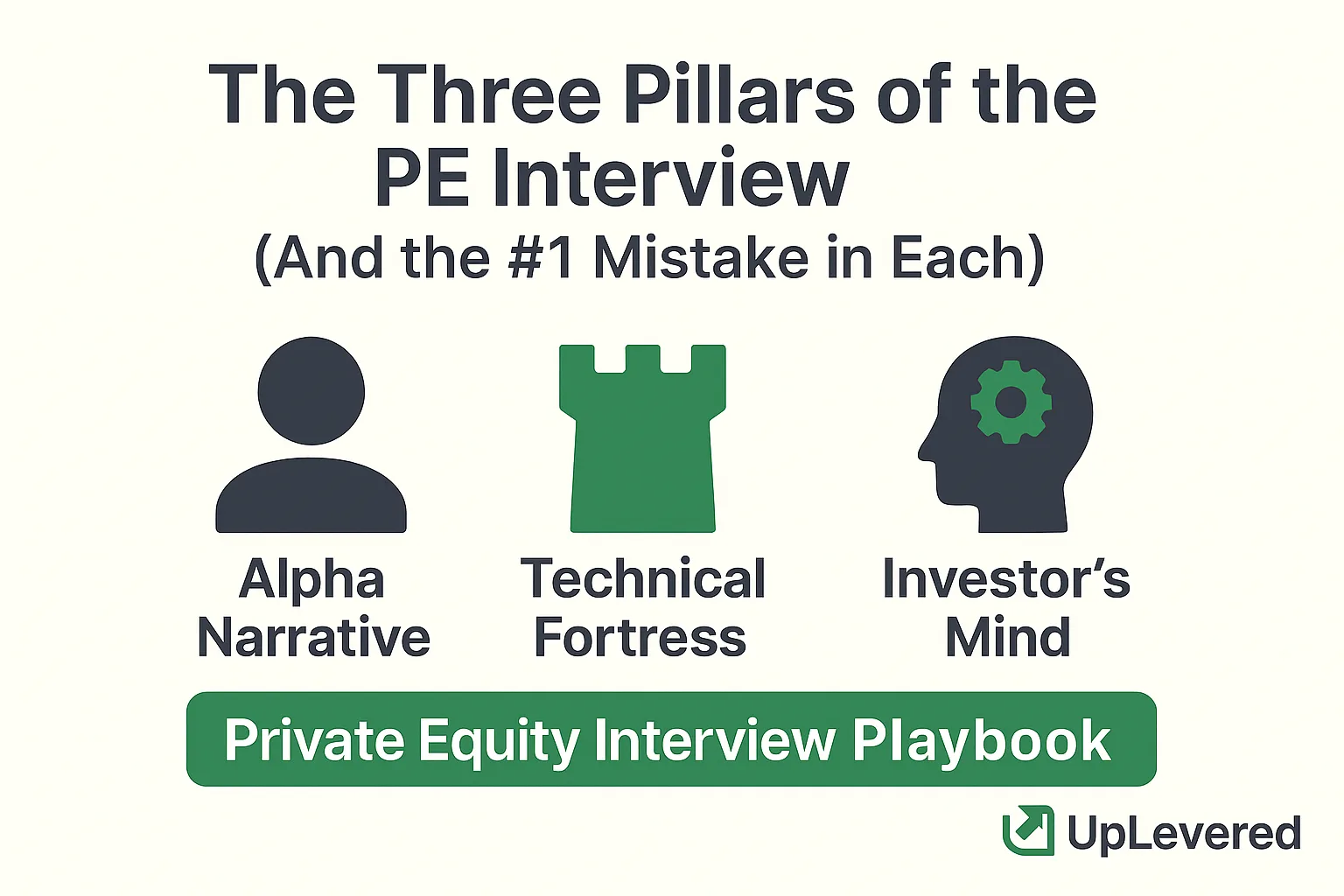
In fact, there are three core pillars you must master to stand out in PE recruiting: The Alpha Narrative, The Technical Fortress, and The Investor’s Mind.
Nail these and you’ll shine; flub them and even a top background might not save you. My goal is to walk you through each pillar, the #1 mistake candidates make in each, and how you can avoid those pitfalls.
(Spoiler: I’ve developed some battle-tested frameworks – like “Past→Pivot→Future,” the “3P method,” and the “5M’s” – to systematically conquer these areas. I’ll walk through the core of each below.)
A Better Private Equity Interview Strategy: The Three Pillars
Pillar 1: The Alpha Narrative
Your Alpha Narrative is your story. It’s the narrative you present in behavioral interview questions – the answer to “Tell me about yourself” or “Why private equity?”. Think of it as your personal alpha: what makes you uniquely valuable compared to other candidates.
An effective Alpha Narrative convinces interviewers you’re the one to bet on, even if you come from a non-traditional path. It weaves together your past accomplishments, the pivot or spark that drives you towards PE, and your vision for the future. Done right, your story showcases your grit, curiosity, and genuine motivation for private equity.
The #1 Mistake – A Disjointed or Generic Story: The biggest mistake in this pillar is failing to connect the dots in your background and make a compelling case for why you belong in PE. Too often, candidates simply recite their resume or downplay their unique experiences. A generic story that could fit anyone (“I like finance and working with companies…”) won’t cut it. The Alpha Narrative is your chance to project confidence (not cockiness) and turn your outsider status into a badge of honor.
Insider Tip: Authenticity Wins
When I was recruiting, I worried that my hedge fund background made me look scattered. But the truth was, I’d always known I wanted to be on the investor side of the table - working with companies, not just trading their stocks. I felt so strongly about it, I left a well-paid role with great hours to grind it out in investment banking in a new city - just to get the reps I knew I’d need for private equity. That pivot became the cornerstone of my story, and ultimately, my edge.
The lesson: Don’t hide from your unique path. Identify the moment your conviction became so strong it led to a difficult but necessary step. That’s the heart of a powerful narrative.
How to Fix It: Start by reflecting on your “pivot” moment – what lit the fire for private equity? Frame your story around that spark. Make sure you hit the three beats: who you are and what you’ve achieved, what drew you to PE, and where you plan to go. If you’re unsure how to structure this, start with the behavioral patterns in our PE interview questions guide and build your Past→Pivot→Future arc from there.
Pillar 2: The Technical Fortress
Private equity interviews will grill your technical skills to ensure you have a rock-solid foundation – your Technical Fortress. This pillar includes your grasp of valuation, accounting, LBO mechanics, and of course the dreaded LBO model test. In plain terms, they want to see that you can handle the numbers and won’t fumble on the job.
The #1 Mistake – “Winging It” (or Shaky Foundations): The most common failure here is under-preparation. I’ve personally felt the sting of messing up an LBO modeling test early in my career because I hadn’t practiced enough. Too many candidates fail because they lack a systematic prep plan and hands-on practice, and instead rely on rote memorization or hoping for easy questions.
How to Fix It: Build your Technical Fortress brick by brick. Start with core accounting, then move to valuation and LBO mechanics. Crucially, practice building an LBO model from scratch until it’s second nature. One pro tip: don’t just memorize formulas – understand why they work, so you can handle any twist. If you’re not sure where to start, follow the LBO build guide and pressure-test yourself with the distribution LBO practice set.
Pillar 3: The Investor’s Mind
Finally, even if you have a great story and ace technical skills, you won’t clinch the offer unless you demonstrate The Investor’s Mind. This is about thinking like an owner. Interviewers will gauge this through case studies, deal discussions, and high-level questions that test whether you get how investors think.
The #1 Mistake – Thinking Like an Applicant, Not an Investor: The common pitfall here is treating these discussions like a school exam. Candidates often make the mistake of not taking a stance. They’ll regurgitate facts (“Company X has revenue of $100M…”) but never state an opinion on whether it’s a good investment! If you can’t discuss market dynamics, competitive advantages, and management team strength, it signals you haven’t developed an investor’s perspective.
How to Fix It: Start analyzing businesses around you with a critical investor lens. Get comfortable forming an investment thesis: “I would invest in Company Y because [key reasons], however I’d be cautious about [key risks].” Show that you can interpret the numbers in context. If you’re unsure how to structure your thoughts, work through the case-style questions in our interview questions guide until taking a stance feels natural.
Final Thoughts on Your Private Equity Interview Strategy
The private equity interview process is rigorous, but if you fortify these three pillars – your personal Alpha Narrative, your Technical Fortress, and your Investor’s Mind – you’ll dramatically improve your odds. We’ve diagnosed the #1 mistakes: a weak story, shaky technical prep, and a lack of investor thinking. The good news? You can avoid all of them.
Now that you know what not to do, drill the specifics: the PE interview questions guide covers the behavioral, technical, and case-style questions you’ll actually face. Use the free Distribution LBO practice set as a warm-up, then work the complete timed test below.
Revision History
- : Migrated to the new UpLevered platform: named author byline, Article schema, update log added.
- : Last pre-migration revision.
- : Original publication.
Stay sharp. Subscribe to Deal Flow Bullet.
PE frameworks, deal analysis, and career intel for middle-market practitioners. Free, every two weeks.