
Ref C-07 · Comp Data · 32 min read · Updated October 2026
Private Equity Salary 2026: Fund Size Data + Carry Calculator
Compare PE pay by level and firm size with Heidrick survey benchmarks, a 2026 recruiter-offer update, and a carry calculator. Cash and carry shown separately.
Private equity compensation combines base salary, annual bonus, and carried interest. Start with the cash attached to your role, then evaluate carry on its own terms. This guide uses published investment-professional survey data to compare smaller and larger managers, adds a current recruiter-offer update, and gives you a calculator for testing the economics of a potential grant. The survey dates and firm-size definitions appear beside the numbers; the methodology explains how to use them for a 2026 offer.
2026 Compensation Calculator
Compare cash and carry using the scenario presets below
Annual Cash Assumption (Base + Bonus): -
Scenario Carry (Divided over 10 years): -
Cash + Annualized Scenario Carry: -
Assumptions: Cash starts at the midpoint of a hypothetical offer range: $275,000 to $350,000 for the selected preset, before the optional adjustment. These presets are separate from the survey benchmarks in this article. The optional 5% cash reduction is a sensitivity assumption, not a measured city pay gap. Carry uses a 90% invested-capital factor, a 20% carry pool, and scenario points in that pool. The $1B / $10B funds, 8% hurdle proxy over five years, and division over ten years are scenario choices. The calculation omits fees beyond the invested-capital factor, vesting, tax, catch-up, clawback, and actual distribution timing. It is not probability-weighted expected value or annual cash income.
Get the free Middle-Market Distribution LBO Model (Excel)
Resume reference:Private Equity Résumé Template
How to read the calculator: its cash presets and carry inputs are hypothetical scenarios, independent of the observed survey tables below. The smoothed carry figure is a fund-life payout divided by ten, not annual income or a probability-weighted expected value. The optional 5% cash adjustment, 90% invested-capital factor, and five-year hurdle proxy are model assumptions. Test the actual offer and fund agreement separately; a delayed exit, forfeiture, or missed hurdle can change the result materially.
Private Equity Salary Overview 2026
Middle-Market Cash Compensation (2026)
Use this $1.00–1.99B total-AUM cohort as one reference for a middle-market discussion. All figures are USD and show the 25th–75th percentile from Heidrick’s 2025 North America investment-professional survey. The source combines Associates and Senior Associates; it does not provide separate analyst or Senior Associate percentiles here.
On small screens, scroll the tables sideways to compare all columns.
| Survey role | 2025 base salary | 2024 annual bonus | 2024 cash (base + bonus) | Responses |
|---|---|---|---|---|
| Associate / Senior Associate | $130k–$170k | $55k–$138k | $180k–$300k | 38 |
| Vice President | $190k–$250k | $120k–$230k | $330k–$435k | 31 |
| Principal | $258k–$358k | $178k–$318k | $468k–$593k | 20 |
| Partner / Managing Director | $350k–$600k | $343k–$738k | $680k–$1.00m | 29 |
Source: Heidrick & Struggles 2025 survey, p. 26. The four displayed roles total 118 responses; the full page’s 128 also includes 10 Managing Partners. These are role response counts, not a count of firms.
The base column covers 2025; the bonus and total-cash columns cover 2024. Do not add different years or add component quartiles to reconstruct a total-cash quartile. The actual payments to one person should reconcile, but separately ranked survey distributions need not.
Analyst recruiting varies by firm. Verify that a formal analyst program exists and whether its seats lead to permanent associate roles.
Middle-Market vs. Mega-Fund Comparison
The table compares two AUM-across-all-funds cohorts from the same survey and the same cash year. The $40B+ category offers a larger-manager reference; it is not a definition of every mega-fund role. Both cash columns are the 25th–75th percentile of 2024 base plus bonus. The base columns are 2025 base only.
| Survey role | $1.00–1.99B AUM: 2024 cash | $40B+ AUM: 2024 cash | $1.00–1.99B AUM: 2025 base | $40B+ AUM: 2025 base | Responses: smaller / larger cohort |
|---|---|---|---|---|---|
| Associate / Senior Associate | $180k–$300k | $300k–$400k | $130k–$170k | $150k–$180k | 38 / 9 |
| Vice President | $330k–$435k | $540k–$645k | $190k–$250k | $230k–$340k | 31 / 11 |
| Principal | $468k–$593k | $670k–$938k | $258k–$358k | $298k–$400k | 20 / 14 |
| Partner / Managing Director | $680k–$1.00m | $1.00m–$1.44m | $350k–$600k | $500k–$938k | 29 / 14 |
Source: Heidrick & Struggles 2025 survey, pp. 26 and 32. The larger cohort has 48 responses across these four roles. Its small samples and different mix of firms prevent treating the gap as a guaranteed pay increase for changing employers.
Analysts and Senior Associates still need separate offer discussions even though this source does not publish separate percentile rows for them. Ask how the firm defines each title, whether the seat is permanent, and which responsibilities change at promotion. Carry access and promotion timing require the same firm-specific check:
| Level | Carry discussion | Promotion question | What to verify |
|---|---|---|---|
| Analyst | Establish whether a grant is included | Does the program lead to an Associate seat? | Permanent program or fixed-term seat; actual promotion history |
| Associate | Some Associate/Senior Associate survey respondents report carry | What distinguishes the next role? | Written grant versus eligibility for a future grant |
| Senior Associate | Establish the grant and any planned increase | What are the VP criteria and decision date? | Points, vesting start, next fund participation |
| Vice President | Make the allocation an explicit offer term | What changes at Principal? | Share of the pool, fund vintage, capital commitment |
| Principal/Director | Compare allocations across fund vintages | What is required for partnership? | Origination expectations, dilution, partner process |
| MD/Partner | Negotiate the share and ownership rights | Who controls future grants and succession? | Carry ownership versus management-company economics |
A larger platform can support a larger pool without giving each employee more economics. Conversely, a smaller team does not guarantee faster promotion or broader ownership. Compare the position’s written responsibilities, the number of people competing for the next seat, and the economics of the specific fund you would join. See the middle-market careers guide for the role comparison beyond compensation.
Methodology & Sources
Review date: October 2, 2026. The latest comparable Heidrick edition located for this review is the 2025 North America Private Equity Investment Professional Compensation Survey, published November 19, 2025. It covers 656 respondents and self-reported compensation for 2023–2025. Its detailed tables are the basis for the investment-team benchmarks above. No 2026 edition was located, so the guide’s review year does not turn those observations into 2026 pay.
A Primary-Survey Cross-Check
The main tables use the survey’s published lower and upper quartiles, rather than its highest response or an assumed annual uplift. The $1.00–1.99B cohort provides a smaller-manager reference; $40B+ provides a larger-manager reference. Neither is a census of the market. Respondents can differ in role scope, city, strategy, tenure, and performance even within one title and AUM bucket.
Heidrick’s methodology, p. 38 notes that many firms target compensation around or above the upper quartile. That describes a benchmarking practice; it does not prove that an independently chosen range is an observed competitive-offer band. Use the published percentile for the stated cohort, then negotiate against the scope and terms of your own offer.
2026 offer update: Charles Aris’s 2026 Mid-Year Private Equity Compensation Report publishes a subset of accepted offers extended by its clients from January through June 2026. Its eight fund-level rows titled simply Associate show $215k–$325k total cash. At $1–5B AUM, two rows show $245k and $315k; at $20–50B AUM, one shows $215k and five show $325k. Each row represents a different candidate.
These are offer examples, not market percentiles or realized bonus payments. The report does not identify those generic Associate rows as buyout deal-team positions, and it also covers portfolio operations and portfolio-company jobs. Keep those functions separate when benchmarking. The rows mark carry as N/A, which does not establish a zero grant. See the primary report for the offer components and definitions.
The 2025–2026 Holt–MM&K report is another current primary source, drawing on 64 participating firms. Its public overview covers investment and other functions; the detailed role tables are in the paid report. This guide does not substitute its headline trends for unseen role-level data.
What the Planning Bands Mean
The calculator’s preset cash ranges and carry shares let you test a hypothetical package. They are model inputs, not survey estimates, personal recruiting observations, or evidence of what a particular firm will pay. The article’s compensation tables use the dated primary evidence above. For an offer decision, compare the preset with the terms actually offered and keep signing payments, recurring cash, and potential carry distributions separate.
For an actual comparison, match four things before comparing dollars: role scope, geography, compensation year, and the definition of fund size. A $1B current fund is not the same as $1B of AUM across every fund the manager runs. An Associate/Senior Associate survey category cannot establish a separate Senior Associate percentile. A total-cash observation includes the bonus actually reported for that period; a current offer may state only a target.
- Cash: base plus annual bonus. Keep a signing payment, deferred bonus, and recurring compensation on separate lines.
- Carry: document the vehicle, share of the pool, vesting and payout conditions. Estimated value is separate from cash received.
- Precision: a survey quartile describes its cohort; a calculator preset describes a scenario. Neither establishes a guaranteed floor for your offer.
- Freshness: the survey’s publication date, its observation years, and this page’s review date differ. The 2026 recruiter offers remain separate from the 2024–2025 survey observations.
The practical question is whether the package fits the work and risk you are taking. A higher first-year bonus may compensate for a fixed-term seat, a deferred payout, or weak visibility on the next fund. A lower cash offer with carry requires equally careful scrutiny: an unvested grant with no credible realization path is not a substitute for salary. Ask for terms you can compare in writing, and model both a successful fund and a delayed or unsuccessful one.
Send corrections or newer primary sources here. I will distinguish new observations from changes to the page’s presentation.
Contents
1 Private Equity Salary Overview 2026
3 Carry 101 (with simple math)
4 Co-Invest 101: Small Checks, Real Upside
5 Private Equity Compensation by Position Level
6 Key Factors Affecting Private Equity Salaries (2026)
7 Private Equity Compensation Components Explained
8 Skills & Qualifications for Private Equity Careers
9 Private Equity vs. Investment Banking Compensation (2026)
10 Exit Opportunities & Career Paths After Private Equity
11 How to Maximize Private Equity Compensation
13 Frequently Asked Questions (FAQs)
Carry 101 (with simple math)
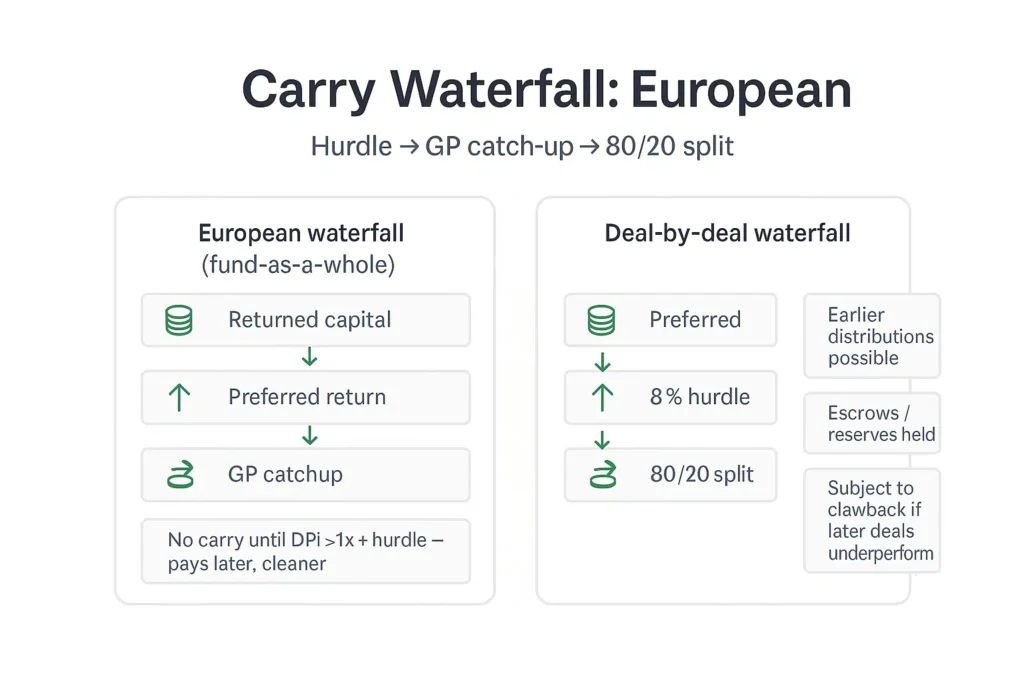
Carried interest (“carry”) is a contractual share of investment profits. This guide uses a 20% GP carry rate and an 8% preferred return as illustrations; the signed limited partnership agreement (LPA) controls. A whole-fund waterfall generally returns the agreed capital and preferred return before carry is distributed. A deal-by-deal structure can pay earlier and may require later repayments. Do not assume one rule applies to every fund or that a higher marked valuation has produced spendable compensation.
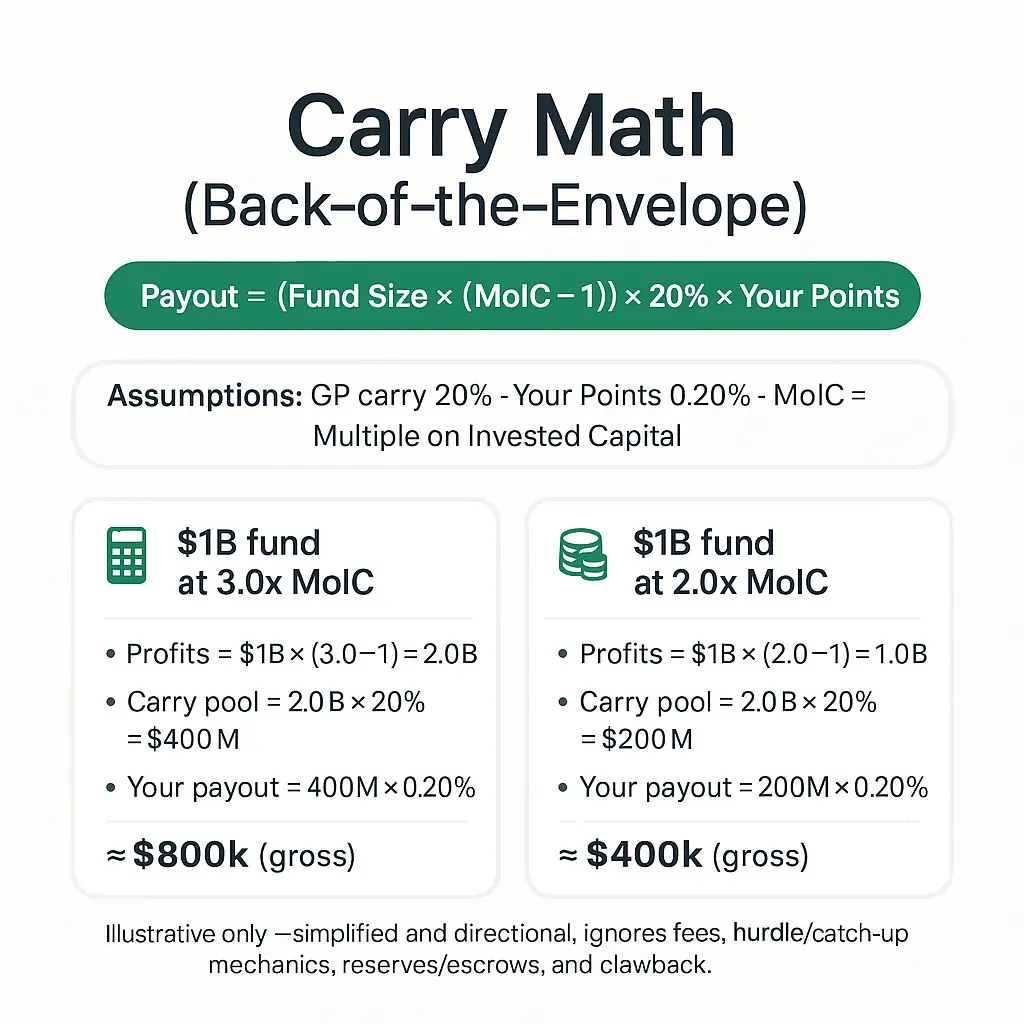
The Carry Formula
Here’s the back-of-the-envelope math, before fees, expenses, hurdle and catch-up mechanics, vesting, taxes, and any required capital contribution. It estimates a scenario over the fund life, not an annual paycheck:
Illustrative payout ≈ (Fund Size × (MoIC − 1)) × Carry% × Your Pool Share
- Example A (3.0× return): $1.0B fund → profits ≈ $2.0B; 20% pool ≈ $400M
At 0.20% points → ~$800k over fund life - Example B (2.0× return): $1.0B fund → profits ≈ $1.0B; 20% pool ≈ $200M
At 0.25% points → ~$500k over fund life
Your carry points represent your share of this 20% pool, not a percent of the fund size or total profits.
Distribution waterfall (fast)
-
Hurdle rate: The agreed preferred return is one condition in the waterfall. This guide uses 8% as an illustration; confirm its calculation base, compounding, timing, and treatment of capital calls.
-
GP catch-up: After the preferred return, a catch-up tier may allocate distributions to the GP until its agreed profit share is reached. That means carry is not always simply 20% of profits remaining after subtracting the hurdle.
-
Distribution method: Funds may use a European (fund-as-a-whole) or deal-by-deal approach, with the latter often involving escrows or reserves to manage risk and timing of carry distributions.
-
Clawback provisions: Protect limited partners by requiring general partners to return previously distributed carry if early distributions exceed their ultimate entitlement.
Vesting & timing: Separate earning the grant from receiving a distribution. A 4–6-year schedule is an illustration, not a universal term; the start date, continuing-service condition, and treatment on departure matter as much as the headline period. Realizations, reserves, and the waterfall determine payment timing. ILPA Principles 3.0 provides LP-focused guidance on waterfall and clawback provisions; your employment and fund documents determine your own rights.
VP Level
Illustrative pool share: 0.1–0.5%
Check the actual grant and vesting conditions
Principal/Director
Illustrative pool share: 0.5–1.5%
Model each vintage and grant separately
Partner/MD
Negotiated share
Share of carry pool, distinct from management-company ownership
Co-Invest 101: Small Checks, Real Upside
Access
Eligibility, minimum check, and allocation priority vary by employee program
Typical Size
$10k–$100k per deal as a planning example, not an observed market minimum or maximum
Terms
Often pari passu with fund; sometimes limited leverage via employee program
Risk
Single-asset exposure, illiquid, capital calls can arrive during dry spells
Get practical PE guides by email.
Private Equity Compensation by Position Level
Career Roles & Responsibilities Quick Reference
- Analyst: Builds models and diligence modules, supports IC. Confirm program length, Associate openings, and any carry grant.
- Associate: Owns workstreams end-to-end (screening → DD → close), coordinates advisors, starts portco projects.
- Senior Associate: Leads diligence modules, mentors juniors, drafts IC narratives; carry availability depends on the firm and grant.
- Vice President: Runs processes, begins origination, manages CEO/banker relationships; negotiate carry alongside cash.
- Principal/Director: Origination engine + IC leadership, sector strategy, team development; compare grants across vintages.
- MD/Partner: LP relationships & fundraising, firm strategy, exit leadership, and governance.
Private Equity Analyst Salary 2026
Base / Bonus / All-in: establish the program’s base, target bonus, and guarantee separately; the investment-professional tables above do not supply a standalone Analyst percentile
Where to look: dedicated analyst programs at larger platforms and individual openings at middle-market firms
What moves you up: Clean, independent diligence workstreams, bullet-proof models, crisp IC materials
Progression & equity: confirm the Associate route, program length, and whether carry or co-investment is included
The analyst role is the entry point at mega-funds and select middle-market shops, typically recruiting from top undergraduate programs with strong internship experience. While finance and banking pipelines still dominate, some firms are increasingly open to non-traditional candidates (e.g., consulting or technical backgrounds) who can contribute immediately to diligence and market work.
Bonuses vary with firm performance and your direct contribution to deal execution. Analysts who run tight workstreams - accurate models, airtight diligence memos, and clear IC exhibits - tend to land at the top of the band.
For a two- or three-year analyst program, establish what happens at the end: an internal Associate review, an external search, or a business-school route. Discuss co-investment and carry separately instead of assuming either is included. Core skills to prioritize: advanced modeling, process management, and portfolio KPI tracking.
Some funds have introduced fast-track promotions for exceptional performers. If you can independently manage diligence modules and materially improve IC readiness, you may move ahead of traditional timelines.
Before taking an analyst seat, ask how the program is staffed and evaluated. A permanent role with direct investment-team exposure has different economics from a two-year program with no internal promotion route. Clarify who owns the model, how analysts participate in diligence calls, and whether portfolio work is part of the job. The useful signal is the responsibility you will actually receive, not the logo alone or the promise that everyone eventually gets to lead a deal.
For the bonus conversation, separate the target from the payment history. Ask whether the first year is prorated, when the review occurs, and whether you must still be employed on the payment date. A quoted $200k package can mean guaranteed salary plus a contractual bonus, or salary plus a discretionary amount that the firm has not committed to pay. Record those differences before comparing two offers at face value.
Build evidence that you can take a workstream from an open question to a defensible recommendation. Keep a redacted record of the assumption you tested, the source you used, the conclusion, and the investment implication. That is stronger promotion evidence than the number of models touched. Ask for feedback during the year so a problem with accuracy, speed, or communication can be fixed before the compensation discussion.
Treat a fast promotion as a possibility to test, not a feature of the entire 2026 market. Ask how many analysts were promoted in the last two classes, what changed in their responsibilities, and whether a vacant associate seat is required. An accelerated title with unchanged decision authority may add less than a slower path with clear underwriting ownership. Discuss the next role and the associated pay review together.
Private Equity Senior Associate Salary 2026
Survey cash benchmark: Associate and Senior Associate are combined: $180k–$300k at $1.00–1.99B AUM and $300k–$400k at $40B+ AUM, the middle 50% of 2024 base plus bonus. The corresponding 2025 base ranges are $130k–$170k and $150k–$180k. See the source and cohort definitions.
What drives pay: Lead diligence modules, mentor juniors, draft IC narratives
Role shift: Bridge between execution and strategy; begin relationship management
Progression & equity: Associate/Senior Associate carry appears in the survey, but it does not establish a standard allocation or first-grant date; discuss the VP timetable and get any grant in writing
Associate seats draw candidates from investment banking and management consulting. The larger-manager cohort above reports higher cash quartiles, while responsibility and performance still shape the individual offer. Clean diligence, crisp IC materials, and tangible portfolio-company results give you specific evidence for the bonus discussion; they do not guarantee a particular percentile.
The day-to-day is broad: build and own the model, coordinate advisors, drive diligence modules, and start managing external relationships (deal sources, management teams). The learning curve is steep but accelerates responsibility - especially at MM shops where teams are leaner.
After-Tax Snapshot (Illustrative)
Assume base $175k + bonus $200k, or $375k in gross cash. At a purely hypothetical 45% effective tax rate, after-tax cash is $206,250. At 35%, it is $243,750, a $37,500 difference. These are arithmetic scenarios, not estimates of the tax owed by a New York or Texas resident.
To compare locations, replace the assumed rate with an estimate for your actual filing status, residence, deductions, payroll taxes, and payment timing. Then deduct housing, commuting, and other recurring costs. A lower headline tax rate does not by itself establish a better offer.

Associate and Senior Associate titles can cover different experience levels across firms. Compare the actual work: independent underwriting, advisor coordination, management interaction, and responsibility for a live diligence stream. A larger bonus does not necessarily come with more decision-making authority. Ask who gives performance feedback and whether the role ends after a set program. The answer affects both the value of the current package and the cost of finding the next seat.
Use the bonus discussion to understand how the firm evaluates contribution. Ask for examples of work that moved someone from the target to a higher payout: a diligence finding that changed price, a financing solution, or an operating initiative that improved cash conversion. Avoid treating the target as a formula unless the agreement actually specifies one. The timing, discretion, deferral, and forfeiture clauses can matter more than a small difference in the quoted percentage.
On a live deal, strong associates connect the model to evidence. If a revenue assumption changes, they can explain what the customer work showed, how the assumption flows through debt capacity and returns, and what additional diligence would resolve the uncertainty. That ability also helps in compensation reviews: it makes individual contribution visible without claiming ownership of the entire investment outcome. Bring a concise set of examples rather than relying on a list of completed transactions.
If an associate offer includes carry, verify that it is a grant rather than an informal possibility. Identify the fund vintage, the number of points, the denominator, vesting start, and any employee capital commitment. Ask what survives a voluntary departure or termination and whether future grants are discretionary. A small allocation can be valuable, but it can also remain illiquid for years or produce nothing. Do not assume it costs no capital or automatically replaces foregone cash.
Private Equity Vice President Salary 2026
Survey cash benchmark: $330k–$435k at $1.00–1.99B AUM and $540k–$645k at $40B+ AUM, the middle 50% of 2024 base plus bonus. The corresponding 2025 base ranges are $190k–$250k and $230k–$340k. See the source and cohort definitions.
Carry illustration: A 0.1–0.5% pool share is a modeling range; a $1B fund at 3.0× with a 0.20% share gives about $800k over fund life before the adjustments described in Carry 101
Role inflection: Run processes end-to-end, begin consistent origination, translate operating levers into value creation
What top VPs do: Build repeatable sourcing pipeline, spot pattern risk in diligence, coach teams, maintain CEO-level trust
Role inflection: VPs run processes end-to-end (advisor orchestration, SPA/credit docs, IC calendars), begin consistent origination, and translate operating levers (pricing discipline, go-to-market, KPI cadence) into underwriting and value-creation plans.
What top VPs do: build a repeatable sourcing pipeline, spot pattern risk in diligence, coach associates/SAs, and maintain CEO-level trust. Communication with management and LPs becomes central to the seat.
At VP, the compensation discussion should reflect the shift from producing analysis to being accountable for a process. An attractive title and cash band do not tell you whether you can shape diligence, negotiate with advisors, or recommend an investment decision. Clarify which workstreams you own, which require partner approval, and how the firm judges a deal that was correctly rejected. That distinction matters when evaluating both the role and its incentive structure.
A VP may coordinate financing, legal work, management diligence, and investment-committee timing while developing an origination network. The offer should make clear how those demands are balanced. If the role expects material sourcing, ask about sector coverage, partner support, and how sourced opportunities are credited. If it is primarily execution, evaluate staffing and the number of simultaneous deals. Neither role is inherently better paid; the package should match the scope being promised.
Portfolio responsibilities also need definition. Ask whether you will attend board meetings, lead a recurring KPI review, or own a specific value-creation project. Identify who has authority to approve spending and who is accountable when an operating plan misses. A broad instruction to create value is difficult to evaluate at bonus time. A written set of responsibilities and an agreed review cycle makes performance easier to discuss with evidence.
For carry, request separate schedules for the current fund and any future fund. A grant in a largely deployed vehicle has a different risk profile from points in a fund that has not closed. Consider remaining investment capacity, concentration, leverage, expected hold periods, and the probability that you stay through vesting. A headline carry value built from a strong return assumption is one scenario; it is not a cash payment the firm has promised.
Team leadership becomes part of the job as well. A VP who can delegate analysis, review it efficiently, and explain the investment implications gives the team more capacity. Keep examples of how you improved a process, developed a junior colleague, or prevented a diligence issue from recurring. Those contributions may not have a neat deal attribution, but they help establish why responsibility and compensation should increase.
When comparing VP offers, build a three-part view: recurring cash, the contractual carry grant, and the work required to earn the next role. Model a flat bonus year and a delayed exit alongside the attractive case. Also include employee capital commitments and any deferred pay. This exposes whether a seemingly larger package simply moves compensation farther into the future or adds risk that your current role does not require.
Private Equity Principal/Director Salary 2026
Survey cash benchmark: $468k–$593k at $1.00–1.99B AUM and $670k–$938k at $40B+ AUM, the middle 50% of 2024 base plus bonus. The corresponding 2025 base ranges are $258k–$358k and $298k–$400k. The source category is Principal; compare a Director’s responsibilities before treating the titles as equivalent. See the source and cohort definitions.
Carry illustration: 0.5–1.5% of the pool; actual points, vesting, and distributions depend on the grant and fund
Seat shift: Origination and IC leadership dominate; sector depth, CEO-level operating cadence, team building
Success signals: Proprietary pipeline coverage, hit rate to LOI/close, realized exits, portco KPI uplift
At Principal/Director, the focus shifts from primarily executing deals to consistently originating them and shaping fund strategy. You lead diligence agendas, own IC narratives, and set the operating rhythm with CEOs - while developing associates/SAs into reliable process owners.
Carry can become a substantial part of a Principal package. Because allocations here are modeled as points of the carry pool (not of total fund profits), outcomes scale with fund size, MoIC, and realization timing. Over multiple vintages, distributions in strong exit periods can exceed annual cash compensation by a wide margin.
A Principal or Director offer needs a clear division between origination, execution, and portfolio oversight. Ask whether the role brings an investment-committee vote, board seats, sector ownership, or management responsibilities. The same title can describe a senior execution professional at one fund and a prospective partner at another. Those differences affect the amount of carry, the path to additional grants, and the evidence expected at each review.
Evaluate a principal grant across multiple outcomes and dates. For example, distinguish the allocation already documented from points expected after a promotion or fundraise. Test what happens if the firm raises a smaller next fund, delays an exit, or adds partners who share future economics. A projected payout should identify whether it covers one fund or several vintages, before or after tax, and whether it assumes full vesting. That makes the comparison useful even when precise outcomes are unknowable.
The partner conversation should include both investment performance and the ability to build a durable practice. Useful evidence includes a repeatable origination channel, sound decisions on deals declined, credible relationships with management teams, and development of junior investors. Ask how those contributions are weighted and who makes the decision. If the path is described only as discretionary, treat that uncertainty as part of the offer rather than assigning full value to a future partner package.
Private Equity Managing Director Salary 2026
Survey cash benchmark: Partner/Managing Director $680k–$1.00m at $1.00–1.99B AUM and $1.00m–$1.44m at $40B+ AUM, the middle 50% of 2024 base plus bonus. The corresponding 2025 base ranges are $350k–$600k and $500k–$938k. Managing Partner is a separate survey category. See the source and cohort definitions.
Carry terms: Negotiated share of the pool; distinguish projected fund-life value from annual distributions
Seat priorities: LP relationships & fundraising, firm strategy, senior hiring, exit leadership, governance
Success signals: DPI/TVPI trajectory, realized exits, fundraising close rate, CEO/board selection quality
At MD, evaluate cash compensation alongside carry participation across multiple vintages. Realized carry can dominate earnings in a successful exit year; in a slow realization period, it may contribute little or no spendable cash. The distribution waterfall and your ownership rights matter as much as the headline allocation.
Day to day, MDs set investment agenda and culture, win capital from LPs, choose and support CEOs, and lead exits. The role blends deal judgment with institution-building: ensuring underwriting discipline, maintaining portfolio KPI cadence, and developing the next generation of partners.
At MD or Partner, unpack the legal and economic interests before comparing totals. Salary, discretionary bonus, carry grants, and ownership of the management company are different claims on cash. The title alone does not establish which ones you receive. A partner in a newly formed firm may also accept substantial fundraising and operating risk, while a senior employee at an established platform may receive a narrower but more defined package.
Review how the senior cash pool is funded and who controls it. Distinguish recurring management-fee economics from transaction-related income, realized investment gains, and one-off distributions. A high payment in an exit year may be a poor guide to the next several years. Ask how compensation changes if fundraising is delayed or a successor fund is smaller. Those scenarios matter for both the firm budget and the amount available for new investment-team hires.
Carry can dominate senior earnings in successful realization periods, but its value remains tied to portfolio outcomes and the grant terms. Avoid converting an aggregate fund-life allocation into a guaranteed annual number. Build a vintage-by-vintage schedule that separates vested rights, unvested rights, expected distributions, and potential clawbacks. Include any personal capital committed to the funds. This helps distinguish an attractive long-term interest from the cash actually available to spend or reinvest.
Senior diligence on the firm should cover succession, decision rights, LP concentration, key-person provisions, and the allocation of economics among existing partners. Discuss who owns important relationships and what happens if a founder leaves. The ability to maintain underwriting discipline and develop the next generation of investors supports the franchise, but a compensation model cannot substitute for a workable governance arrangement. Review that arrangement before assigning value to the partner title.
Key Factors Affecting Private Equity Salaries (2026)
Firm Size & Strategy
Firm size affects the resources available for compensation, but there is no single fund-size premium that can be applied to every offer. Match AUM across all funds with AUM across all funds, or current-fund size with current-fund size. Then compare the same role and compensation period. Middle-market and mega-fund labels are useful shorthand for discussing the role; the exact AUM cohorts in the tables are more useful for comparing the data.
Fund Size Gradient at a Glance
| Scale | Cash comparison | Carry question |
|---|---|---|
| Lower middle market | Check the specific firm’s budget and a matched AUM cohort | Is the grant in a funded vehicle, and does it require personal capital? |
| Middle market | The $1.00–1.99B total-AUM cohort above offers one reference | What is your share, which vintage is covered, and what changes at promotion? |
| Larger managers | The $40B+ cohort above reports higher cash quartiles for the four displayed roles | How are economics allocated across teams, strategies, and future hires? |
Strategy and track record also matter. A specialist platform may hire for sector judgment, origination relationships, or an operating skill that is difficult to replace. That can change an individual offer without proving a universal premium for the sector. Assess the current fundraising position and the economics of the team you would join. A large pool at the manager level does not reveal your personal allocation, and strong past returns do not guarantee the next fund result.
Geography
Compare New York, San Francisco, Boston, Chicago, Los Angeles, Austin, Dallas, and Miami using actual local offers where possible. A claimed city premium can reflect a different mix of firms and roles rather than pay for identical work. The sources reviewed here do not establish a universal 20–25% coastal premium or a 10–15% second-tier premium, so this guide does not apply those multipliers to its tables.
Build a personal comparison with recurring cash, the expected working arrangement, commuting costs, housing, and an individualized tax estimate. Clarify whether the position is tied to a specific office and whether relocation assistance is repayable if you leave. The calculator’s optional cash adjustment is a sensitivity assumption; it is not a measured discount for any city.
Fund Performance & Deal Flow
- Bonus terms differ. A strong fund may support a larger pool, but individual payouts can remain discretionary. Confirm the measures, payment date, and employment conditions.
- Deal flow changes workload. A busy pipeline can create opportunities to demonstrate judgment and execution, but hours alone do not establish contribution or guarantee a larger payout.
- Carry can be material for seniors. Model the timing and uncertainty of distributions separately from the recurring cash needed between exits.

Private Equity Compensation Components Explained
Base Salary
Base salary is your foundation - the predictable layer that pays the rent while you wait for performance-driven payouts. The reported base-pay ranges rise with seniority; the change attached to your own promotion depends on the role and offer.
- Dated benchmark: in the $1.00–1.99B total-AUM cohort, 2025 base middle-50% ranges are $130–170k for Associate/Senior Associate, $190–250k for VP, and $258–358k for Principal. The larger-manager comparison appears above.
- Key modifiers: role scope, fund scale, geography, and strategy. Use matched observations rather than an automatic percentage premium.
- Senior reality: realized carry can dominate earnings in a successful exit year; base still supports cash-flow stability between distributions.
Annual Bonus
A bonus may depend on the firm, fund, team, individual, or a discretionary judgment that combines them. Ask which factors apply to your role, when they are assessed, and what portion is guaranteed in writing. The table shows 2024 bonus dollars, at the 25th–75th percentile, for the same two Heidrick AUM cohorts. These are observed bonus ranges rather than a promised percentage of your current base.
| Survey role | $1.00–1.99B total AUM | $40B+ total AUM |
|---|---|---|
| Associate / Senior Associate | $55k–$138k | $153k–$253k |
| Vice President | $120k–$230k | $280k–$400k |
| Principal | $178k–$318k | $355k–$598k |
Source: Heidrick 2025 survey, pp. 26 and 32, linked under Methodology & Sources. Dividing a bonus quartile by a separately ranked base quartile does not give an observed bonus-rate percentile.
- Top-end drivers: leading diligence, sourcing wins, tangible portco improvements, and fundraising impact push you toward the upper bands.
Carried Interest (the wealth engine)
Carry is your contractual share of the GP carry pool. This guide uses a 20% GP rate for illustration. The waterfall determines capital return, preferred return, catch-up, reserves, and profit splits; those terms can produce a different result from simply taking 20% of residual profit. Your pool share is separate from the GP carry rate and from ownership of the management company.
When it starts: carry can begin before VP. Heidrick reports carry for the combined Associate/Senior Associate category in its 2025 survey, p. 26, but that table does not measure how often all Associates receive it or when their first grant arrived. At every level, establish the documented allocation rather than treating the title as an entitlement.
Vesting & payout: a 4–6-year schedule is an illustration, not a universal standard. Confirm the start date, any continuing-service conditions, leaver treatment, and the timing of actual distributions.
Back-of-the-envelope math: Payout ≈ (Fund Size × (MoIC − 1)) × 20% × Your Points (MoIC = Multiple of Invested Capital). Example: a $1B fund at 3.0× → profits ≈ $2.0B; 20% pool ≈ $400m; at 0.25% points ≈ $1.0m over fund life. See Carry 101.
Benefits That Actually Move the Needle
- Signing / relocation: bridge forfeited bonus or timing gaps.
- Co-invest access: invest alongside the fund - ideally fee/carry-free - with clear caps.
- Deferred comp: more common at larger funds; know vesting and forfeiture rules.
- Learning budget: executive coaching, certifications, and exec-ed that compound your value.
Skills & Qualifications for Private Equity Careers
Breaking into PE is a high-bar sport. The good news: the bar is visible. This section frames the standard at top funds, shows you how to signal it, and gives you a concrete plan to level up - so you’re not guessing what “good” looks like.
What Gets You Hired (and Promoted)
- Rock-solid technical core: this is the price of admission. You should be able to build an LBO from scratch, link three statements, handle debt schedules, and sanity-check returns (IRR/MoIC). Add QoE literacy and credible downside cases so your models survive IC scrutiny.
- Process ownership: run clean diligence workstreams end-to-end - coordinate advisors, manage the VDR, track issues, and hit IC calendars without drama. Basic SPA/credit-doc familiarity keeps docs moving instead of stalling at signatures.
- Operating edge: translate spreadsheets into outcomes. Pull the levers that move value - pricing discipline, GTM focus, margin expansion, cash conversion - and install a KPI cadence with portfolio teams.
- Sourcing engine: build banker/founder loops, keep a tight CRM, and maintain a repeatable funnel from intro → qualified screen → LOI. Origination isn’t magic; it’s cadence plus credibility.
- Executive-caliber communication: deliver a one-slide “so what,” frame risks and alternatives, and earn CEO/board trust. Attribute impact without grandstanding.
- Judgment & integrity: protect the downside, escalate early, and never trade reputation for a quick win. Partners notice.
Own the workstreams that move deals and KPIs. Do that consistently and compensation follows.
Your “Proof Pack” - Show, Don’t Tell
Recruiters and partners believe artifacts more than adjectives. Assemble a light, airtight portfolio you can share safely.
- Redacted IC memo: thesis, underwriting edge, key risks, and how you mitigated them - no confidential numbers.
- KPI lift dashboard: before/after metrics you moved (ARR, churn, gross margin, cash conversion) and your role in the change.
- Deal log (concise): pipeline → diligence → close; your responsibilities, decisions made, and outcomes; include manager references.
- One 2-page pitch: a recent long or deal thesis with catalysts and a simple risk/reward tree.
Redact anything sensitive. The goal is signal, not data leakage.
Level-Up Roadmap
| Level | Must-have | Bonus signal |
|---|---|---|
| Analyst | Flawless models, tight diligence modules, crisp exhibits | Own a mini-workstream; automate a recurring analysis |
| Associate | End-to-end workstream ownership; advisor orchestration | Source a live deal or prove an operating lever with measured ROI |
| Senior Associate | Lead modules; mentor juniors; draft the IC narrative | Credible origination pipeline; KPI cadence you installed at a portco |
| Vice President | Run full processes; pattern recognition in diligence; CEO trust | Repeatable sourcing engine; board-quality materials that de-risk IC |
Core competencies by level and the signals that accelerate promotion
Backgrounds That Convert
- IB / Consulting: classic feeders - prove you owned more than tabs and slides by showing workstream leadership and decisions.
- Operators (finance, revenue, product): bring KPI wins and change management; translate operating proof into underwriting logic.
- Big 4 TAS / QoE: advantage on quality of earnings and downside scenarios; add independent modeling reps to round it out.
- Data / Analytics: cohorting, pricing experiments, GTM instrumentation - connect the dots to $ outcomes and cash flow.
School names help. Measurable impact helps more. Bring artifacts.
Common Pitfalls to Avoid
- Vague attribution: “supported a deal” ≠ owned a workstream. Be specific about inputs, decisions, and results.
- Model-only profile: great tabs, no process or operating evidence. Add diligence logs and KPI work to balance the story.
- Confidentiality misses: sharing sensitive details kills trust. Redact and summarize instead.
- Spray-and-pray networking: volume without value. Build targeted banker/founder loops and track hit rate.
30-Day Prep Sprints (if you’re breaking in)
- Week 1: rebuild an LBO from scratch; write a 1-page IC “so what” for a recent buyout.
- Week 2: draft a redacted diligence memo and a downside case; practice a 10-minute IC pitch.
- Week 3: assemble a mini KPI dashboard from a public comp; propose three value-creation levers.
- Week 4: build a banker/founder outreach list; secure five warm intros and track hit rate.
Convert these outputs into your Proof Pack and bring them to interviews.

Private Equity vs. Investment Banking Compensation (2026)
For junior finance pros, moving from investment banking (IB) to private equity (PE) is a classic pivot. Here’s the head-to-head so you can decide with eyes open.
The Head-to-Head Comparison
- Compensation: compare recurring base and bonus for the same experience level, geography, and year. The primary sources reviewed here do not provide a matched PE-versus-IB sample that establishes a universal cash premium. Assess carry separately: the grant can add long-term upside without increasing this year’s spendable cash.
- Lifestyle & workflow: IB = high, steady grind tied to clients and deadlines. PE = spike-y peaks around live deals and portco fire drills; calmer between cycles.
- The work itself: IB builds market breadth and process muscle. PE pushes ownership thinking - underwriting judgment, operating levers, and long-term value creation.
- Career progression: compare the actual promotion ladder and available seats. In PE, ask when carry grants enter the package and what work or tenure earns the next allocation.
- Risk & reward: salary is more predictable than a discretionary bonus in either field. PE carry adds illiquidity, vesting, and investment risk; compare downside scenarios as well as potential upside.
Juniors vs. Seniors: Two Timelines
Juniors: put the two actual offers side by side. For a simple illustration, $275k of recurring cash versus $350k produces a $75k pretax difference; those inputs are not an observed industry premium. Check the guaranteed portion, first-year proration, deferred amounts, hours, program duration, and promotion route before assigning the win to either industry. The larger headline is not always the larger recurring payment.
Seniors: at Principal/MD, evaluate realized carry alongside cash rather than assuming a grant will pay on schedule. A successful series of exits can produce large distributions across vintages; an extended holding period can leave the same grant illiquid. Compare the banking package’s cash and deferred compensation with that timing and investment risk.
How to Choose: Quick Checklist
- Your goal: Market/client breadth → IB. Ownership & ops depth → PE.
- Risk appetite: Prefer certainty → IB. Comfortable with long-term upside → PE.
- Timeline: Value a structured path → IB. Want earlier equity participation → PE.
- Fit: Consider local ecosystems (deal flow, portcos, clients) and lifestyle realities - not just year-one cash.
The worked cash difference is illustrative; use the terms of your actual offers to make the decision.
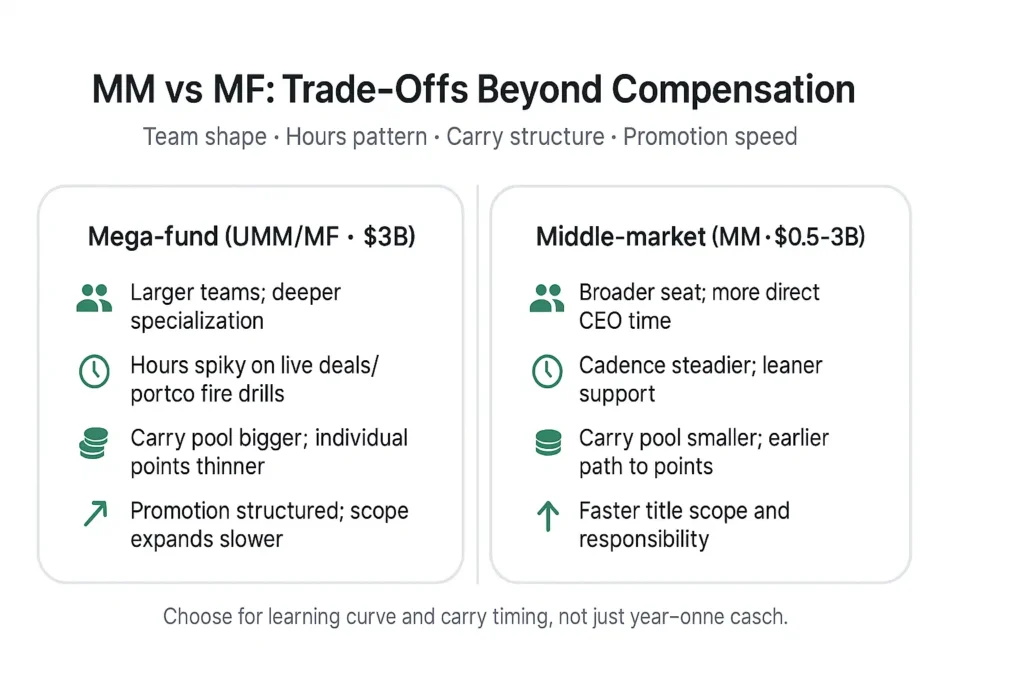
MM vs. MF: The Trade-Offs Beyond Compensation
- Team & role: Mega-fund teams are larger and more specialized, so you’ll go deep in a specific area. Middle-market roles are broader, with more direct CEO interaction and earlier ownership of full workstreams.
- Lifestyle: MF hours are spiky, clustering around live deals and portco “fire drills.” MM can be more predictable, but teams are leaner so there’s less support.
- Career & equity: a leaner middle-market team can offer broader responsibility, but promotion depends on the firm and available seats. A mega-fund can have a larger pool, but your documented share and the grant terms determine personal economics.
- Decision: choose based on the learning curve you want and when you hope to see carry, alongside year-one cash compensation.
Exit Opportunities & Career Paths After Private Equity
PE skills translate across finance. Here’s where professionals typically land:
| Path | Why PE Skills Fit | Comp Shape |
|---|---|---|
| Hedge Fund | Underwriting rigor, catalyst mapping | Cash-heavy, performance bonus |
| Growth/VC | Pattern spotting, founder empathy | Lower cash, longer carry |
| Portfolio Exec | KPI cadence, value playbooks | Cash + meaningful equity |
| Corp Dev | Deal process, integration | Corporate comp + RSUs |
| Entrepreneurship | Sourcing engine, equity story | High variance, equity-driven |
How to Maximize Private Equity Compensation
Your Compensation Playbook
- Develop a specialized edge: be the go-to on operating levers (pricing, GTM, margin), digital/analytics, or a sector where your fund hunts. Specialists get paid.
- Translate work into dollars: tie projects to KPI lift (ARR growth, cash conversion, churn, gross margin). Log wins for review and IC.
- Build a sourcing machine: banker/founder loops, CRM hygiene, and a monthly hit-rate to qualified leads.
- Own the process: clean IC materials, on-time closes, and a crisp 100-day plan with measurable owners and dates.
- Board-ready communication: summarize risk, alternatives, and “so what” in one slide; this moves bonuses up the band.
Sourcing Math (what good looks like)
| Funnel stage | Target cadence | Quality bar |
|---|---|---|
| Top-of-funnel intros | 40–60/mo | Warm intros & repeatable lists, not spray-and-pray |
| Qualified screens | 8–12/mo | Clear “why us / why now,” quick disqualify discipline |
| LOIs | 1–2/quarter | Underwriting edge identified; CEO trust established |
| Closes | 2–4/year (team-dependent) | Clean processes; integration plan ready at sign |
Numbers are directional. Quality beats quantity, and your fund’s strike zone narrows or widens the funnel.
Timing Your Career Moves
- Time the calendar: move after bonus and realized carry distributions to avoid forfeits.
- Time the fundraise: negotiate points when a new fund is forming and the pie is being sliced.
- Time your story: go to market right after exits or measurable portco wins; that’s when your narrative is hottest.
Negotiation Levers (total package)
- Title & scope: written remit (sourcing %, IC role) with a date-certain first review.
- Bonus mechanics: target + floor + discretionary upside language.
- Carry: points of the pool, vesting schedule (cliff + straight-line), vesting credit for prior service, and acceleration on termination without cause.
- Distribution terms: waterfall (European vs. deal-by-deal), escrows/reserves, and clawback obligations.
- Co-invest: access, caps, and whether employee allocations are fee/carry-free.
- Bridging economics: sign-on/relocation to offset forfeits; garden-leave clarity; start date relative to payouts.
Before signing, run the math in Carry 101 and confirm definitions in the LPA/agreements. The fine print is the comp.
Offer Deconstruction (worksheet)
| Term | Why it matters | What “good” looks like |
|---|---|---|
| Base / Bonus target | Cash today | Target + floor; clear drivers and timing |
| Carry points | Wealth engine | Documented points; path to step-ups at milestones |
| Vesting | When you earn it | 1-yr cliff + straight-line; credit for prior service |
| Acceleration | Downside protection | Without-cause = partial/full vesting acceleration |
| Distribution method | Timing of payouts | European vs. deal-by-deal; escrow/reserve clarity |
| Clawback | Payback risk | Cap, duration, and net-of-tax treatment spelled out |
| Co-invest | Additive upside | No fee/carry; clear caps; financing option if offered |
| Non-compete / Garden leave | Mobility & timing | Scope, geography, duration proportionate |
| Start date vs. payouts | Don’t forfeit | After bonus/distribution or bridged with sign-on |
| Review cycle | Raises & title | Date-certain review; criteria tied to outcomes |

Conclusion
Compare a private equity offer in three layers: cash that is contractually committed, compensation that remains discretionary, and long-term interests that depend on vesting and investment outcomes. The distinction is more useful than a single all-in headline. Use the dated survey tables to understand the stated AUM cohorts, the current recruiter examples to see selected recent offers, and the calculator to test your own assumptions.
The right seat should also develop the skills that support the next one. Evaluate the quality of deal exposure, feedback, management access, and the path to taking responsibility. A promotion story is more credible when the firm can explain the work required, the review process, and the economics that change with the role. Bring those questions to the discussion alongside the salary and bonus numbers.
Before accepting, put the offer terms into one worksheet and reconcile every component. Identify the source and year for each benchmark, separate cash from carry, and run a downside case. Then check the employment and fund documents against what was discussed. This keeps the decision grounded in the package you can actually receive, rather than the most attractive number in a compensation guide.
Timing Your Move (final recap)
- Move post-bonus: let the cash land before you walk. Avoid preventable forfeits.
- Negotiate pre-fundraise: push for points when a new fund is forming and the pie is being sliced.
- Don’t leave before a distribution: know the payout calendar. Confirm vesting credit and distribution timing so you’re not stepping over dollars to pick up dimes.
More detail in How to Maximize Compensation. Ranges are directional; your outcome swings with strategy, city, and timing.
The Pre-Signature Checklist
Your total comp is a bundle of levers. Optimize the package - not just the base:
- Title & scope: SA vs. VP (or higher) with remit in writing (sourcing %, IC role) and a date-certain first review.
- Bonus mechanics: target + floor + discretionary upside language and payment timing.
- Carried interest: points in the carry pool, vesting schedule (cliff + straight-line), vesting credit for prior service, and acceleration if terminated without cause.
- Distribution terms: waterfall method (European vs. deal-by-deal), escrows/reserves, and clawback treatment.
- Co-invest: access, caps, and whether employee allocations are fee/carry-free (and any leverage facility).
- Bridging economics: sign-on/relocation to offset forfeits; start date set relative to payouts.
- Restrictions: non-compete / garden leave - scope, geography, and duration proportionate to the seat.
- First review cycle: date-certain performance/title review tied to measurable outcomes.
Before you sign, run the math in Carry 101 and sanity-check terms against the LPA/agreements. The fine print is the comp.
Frequently Asked Questions (FAQs)
Quick Answers
What is the “average” private equity salary in 2026?
Use a role and firm-size benchmark rather than one industry average. In Heidrick’s 2025 survey, the middle 50% of 2024 cash at firms with $1.00–1.99B total AUM was $180k–$300k for Associate/Senior Associate, $330k–$435k for VP, $468k–$593k for Principal, and $680k–$1.00m for Partner/MD. The $40B+ cohort reports higher ranges. These are dated survey observations, with carry separate; the guide also includes January–June 2026 recruiter-offer examples.
How does PE compensation compare to investment banking?
Compare recurring base and bonus at the same experience level, location, and compensation year, then evaluate PE carry separately. The primary sources reviewed here do not establish a universal PE cash premium over banking. Carry can create substantial long-term upside, but vesting, fund performance, and distribution timing determine what you receive. A larger projected carry value is not a larger annual paycheck.
When do private equity professionals start receiving carried interest?
Carry can start at Associate or Senior Associate: Heidrick reports carry for that combined category as well as more senior roles. The survey does not establish a universal first-grant level or the percentage of all Associates who receive it. Ask whether your offer includes a grant now, which fund it covers, the share of the pool, capital required, vesting, and leaver terms. Vesting earns the right; the fund’s realizations and waterfall determine when cash can be distributed.
What skills matter most for success in PE?
The core skills are the price of admission: financial modeling, deal diligence, process management, and clear communication. The skills that truly set you apart are understanding operational levers (like pricing, GTM strategy, and margins), driving a performance-focused KPI cadence with portfolio companies, and building a genuine sourcing engine. At the end of the day, relationship judgment beats raw hours.
How do I maximize my PE compensation?
Deliver tangible results by tying your work to KPI improvements, build a network that generates proprietary deal flow, and develop a true operational edge. Most importantly, negotiate the entire package: carry points, vesting schedule, acceleration clauses, distribution terms, and co-investment rights.
Carry Mechanics in 60 Seconds
How is carry calculated?
The back-of-the-envelope formula is:
Payout ≈ (Fund Size × (MoIC − 1)) × GP Carry % × Your Points
(MoIC stands for Multiple on Invested Capital). This simple formula ignores fees, hurdles, and other complexities, which are covered in our full Carry 101 guide.
What’s a European vs. a deal-by-deal waterfall?
A European waterfall (fund-as-a-whole) pays out later, but the calculation is cleaner. A deal-by-deal waterfall can pay out earlier but is often subject to a clawback, meaning if later deals lose money, you may have to give back some of your earlier distributions.
Do private equity associates get carry?
Some do. Eligibility can differ even between people with the same title. Ask whether the offer includes an actual carry grant, when it vests, what happens on departure, and whether participation requires capital. A co-investment opportunity is a separate investment with its own funding requirements; it is not the same as receiving carry.
Sources & Notes
The October 2 review uses published primary sources: Heidrick’s 2025 investment-professional survey and Charles Aris’s January–June 2026 accepted-offer examples, with scope and dates under Methodology & Sources. No personal recruiting dataset or new interviews are claimed. Cash, hypothetical carry, and realized distributions stay separate throughout the comparison.
Resume Template Interview Guide MM Careers Guide
Prepare for the next conversation with the Private Equity Resume Template.
Revision History
- : Replaced unsupported pay bands with dated Heidrick investment-professional benchmarks by role and total AUM; added a separate January–June 2026 recruiter-offer update. Corrected carry eligibility, banking comparison, personal-observation claims, and metadata; kept calculator presets as hypothetical scenarios.
- : Added survey response counts and changed the salary framing and metadata. The October 2 source review supersedes the practitioner attribution and upper-quartile reconciliation used in this revision.
- : Reviewed primary compensation sources, added a dated survey cross-check, separated editorial planning bands from observed data, and clarified offer, carry, and calculator assumptions. No new 2026 compensation observations were claimed.
- : Migrated to the new UpLevered platform: named author byline, Article + FAQ schema, update log added; compensation calculator carried over unchanged.
- : Last pre-migration revision.
- : Original publication.
Stay sharp. Subscribe to Deal Flow Bullet.
Get practical PE guides by email.