
Paper LBO walkthrough & practice
Take out a pencil. Work through the buyout one step at a time, then try a fresh deal on your own.
Guided example
Guided example Step 1 of 4
Write the equity check
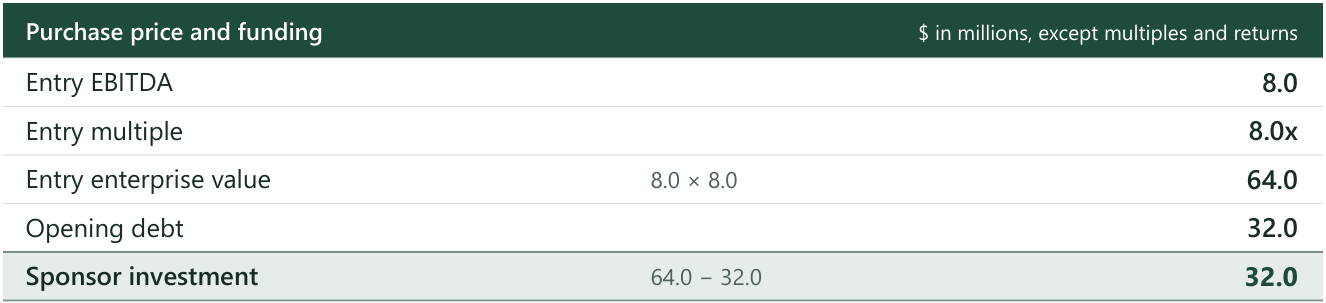
You buy a business for 8.0x its $8.0m of EBITDA. New debt funds $32.0m of the purchase. With no fees or additional cash funding, how much equity must the sponsor invest?
| Entry EBITDA | $8.0m |
|---|---|
| Entry multiple | 8.0x |
| Entry enterprise value | Write your answer on paper |
| Opening debt | $32.0m |
| Sponsor investment | Write your answer on paper |
Show the work
Sponsor investment = entry enterprise value − opening debt.
Multiply $8.0m by 8.0x to price the business at $64.0m. The lender supplies $32.0m. The sponsor writes the other $32.0m check.
Check your work Add the debt and sponsor investment. Together they should fund the $64.0m purchase.
Guided example Step 2 of 4
Put the cash to work
Over the five-year hold, how much cash can the business use to pay down its loan? Carry the opening debt from step 1 into your calculation.
The amounts on the worksheet are totals for all five years. Cash interest and cash taxes are supplied assumptions. Use them directly.
| Cumulative EBITDA | $46.0m |
|---|---|
| Less cash interest | $10.0m |
| Less cash taxes | $8.0m |
| Less capex | $10.0m |
| Less working-capital investment | $2.0m |
| Cash available before principal repayment | Write your answer on paper |
| Debt repaid | Write your answer on paper |
| Ending debt | Write your answer on paper |
| Retained cash | Write your answer on paper |
Show the work
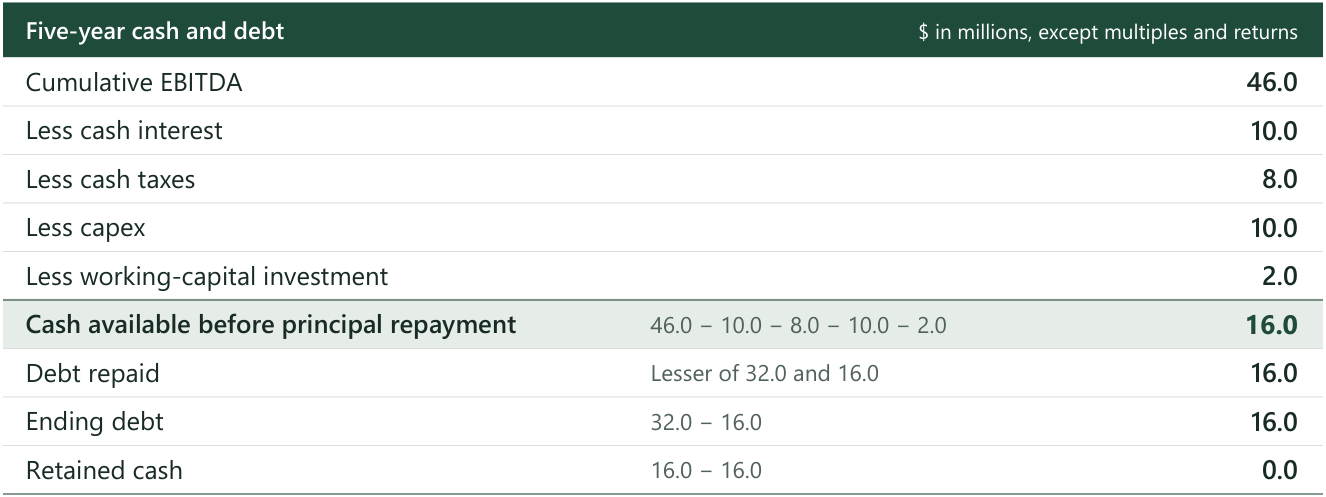
Cash available before principal repayment = cumulative EBITDA − cash interest − cash taxes − capex − investment in working capital.
Start with $46.0m. The four cash outflows total $30.0m. That leaves $16.0m available to repay the $32.0m loan. Ending debt is $16.0m and retained cash is $0.0m.
Check your work Debt repaid plus retained cash should equal the $16.0m available. Cash interest has already been deducted.
Guided example Step 3 of 4
Bring the equity home
Year-five EBITDA is $10.0m. A buyer pays 8.0x. Use your ending debt and retained cash from step 2 to work out what the sponsor receives.
| Year-five EBITDA | $10.0m |
|---|---|
| Exit multiple | 8.0x |
| Exit enterprise value | Write your answer on paper |
| Less ending debt | Write your answer on paper |
| Plus retained cash | Write your answer on paper |
| Sponsor proceeds | Write your answer on paper |
Show the work
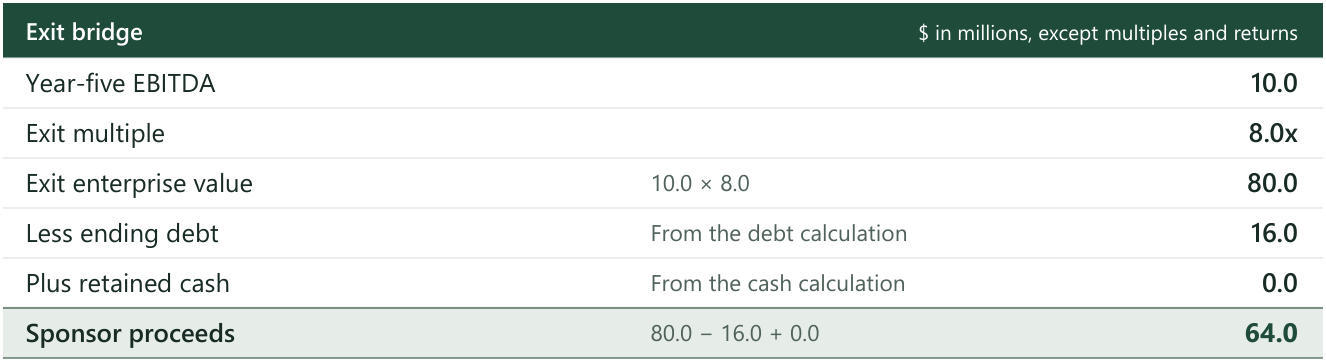
Sponsor proceeds = exit enterprise value − ending debt + retained cash.
The sale values the business at $80.0m. The lender is still owed $16.0m, and the business has $0.0m of retained cash. The sponsor receives $64.0m at closing.
Check your work If you got $80.0m, you have the buyer’s price for the business. Subtract the lender’s remaining claim.
Guided example Step 4 of 4
Explain the return
How many times its money does the sponsor make? Estimate the annual return. How much of the increase in equity value came from EBITDA growth, and how much came from debt repayment?
Use the sponsor’s investment and the cash it receives at exit. The sponsor has a five-year hold and receives no interim distributions.
| Sponsor investment | Write your answer on paper |
|---|---|
| Gain from EBITDA growth | Write your answer on paper |
| Gain from debt repayment | Write your answer on paper |
| Sponsor proceeds | Write your answer on paper |
| Sponsor MOIC | Write your answer on paper |
| Annualized return | Write your answer on paper |
Show the work
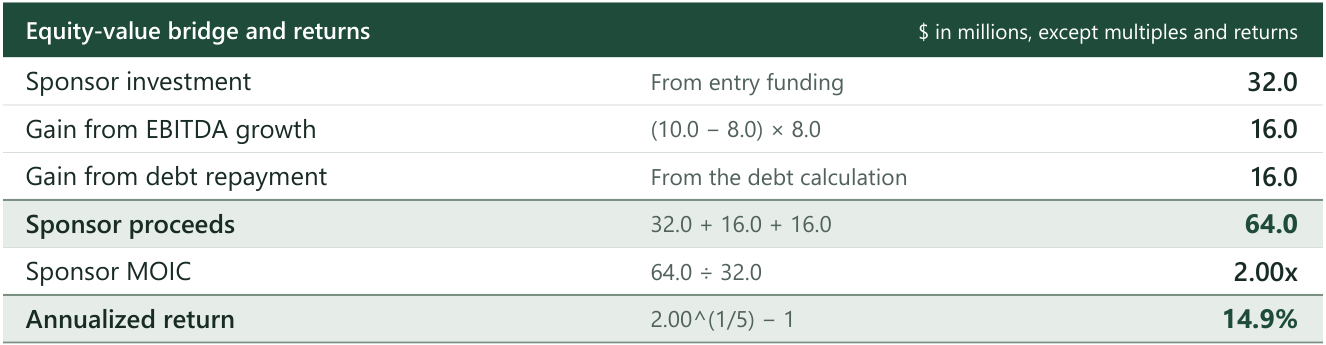
MOIC = sponsor proceeds ÷ sponsor investment.
$64.0m ÷ $32.0m = 2.00x. Two handy five-year anchors are 2.00x ≈ 15% a year and 2.50x ≈ 20% a year. For a multiple between them, estimate between those rates. Here the sponsor doubled its money, so about 15% is a good paper answer.
With one investment at entry and one payment at exit, annualized return = MOIC(1 / years held) − 1. The exact calculation gives 14.9% to one decimal.
Equity-value bridge. EBITDA grew by $2.0m. At the same 8.0x multiple, that adds $16.0m to equity value. Repaying $16.0m of debt adds the other half.
$32.0m increase in equity value
Check your work The two gains plus the original $32.0m investment should land on $64.0m of proceeds. The exit multiple stayed at 8.0x.
Fresh practice
Try this deal independently. Work out your answer before opening the check below.
Use the same cash policy. This business sells at a lower multiple than you paid. Calculate the sponsor investment, cash available before principal repayment, ending debt and retained cash. Then give the sponsor proceeds, MOIC and approximate annual return.
At entry
- Entry EBITDA
- $6.0m
- Entry multiple
- 7.0x
- Opening debt
- $18.0m
Five-year totals
- Cumulative EBITDA
- $38.0m
- Cash interest
- $4.0m
- Cash taxes
- $6.0m
- Capital expenditures
- $3.0m
- Investment in working capital
- $1.0m
At exit
- Year-five EBITDA
- $8.0m
- Exit multiple
- 6.0x
- Hold period
- 5 years
Interest and taxes are supplied five-year cash totals. Use year-five EBITDA to price the exit.
Check my answer
The sponsor invests $24m and receives $54m after five years. That’s 2.25x its equity, or about 18% a year.
Entry. Paying 7 × $6m gives a $42m purchase price. After $18m of acquisition debt, the equity check is $24m.
Cash and debt. Subtract $4m of interest, $6m of taxes, $3m of capex and $1m of working-capital investment from $38m of cumulative EBITDA. The $24m left repays the entire $18m loan and leaves $6m in cash.
Exit and returns. At 6 × $8m, exit enterprise value is $48m. Add the $6m cash balance to get $54m of equity proceeds. Divide by the original $24m for 2.25x. The five-year annualized return is 2.251/5 − 1, or 17.6%.